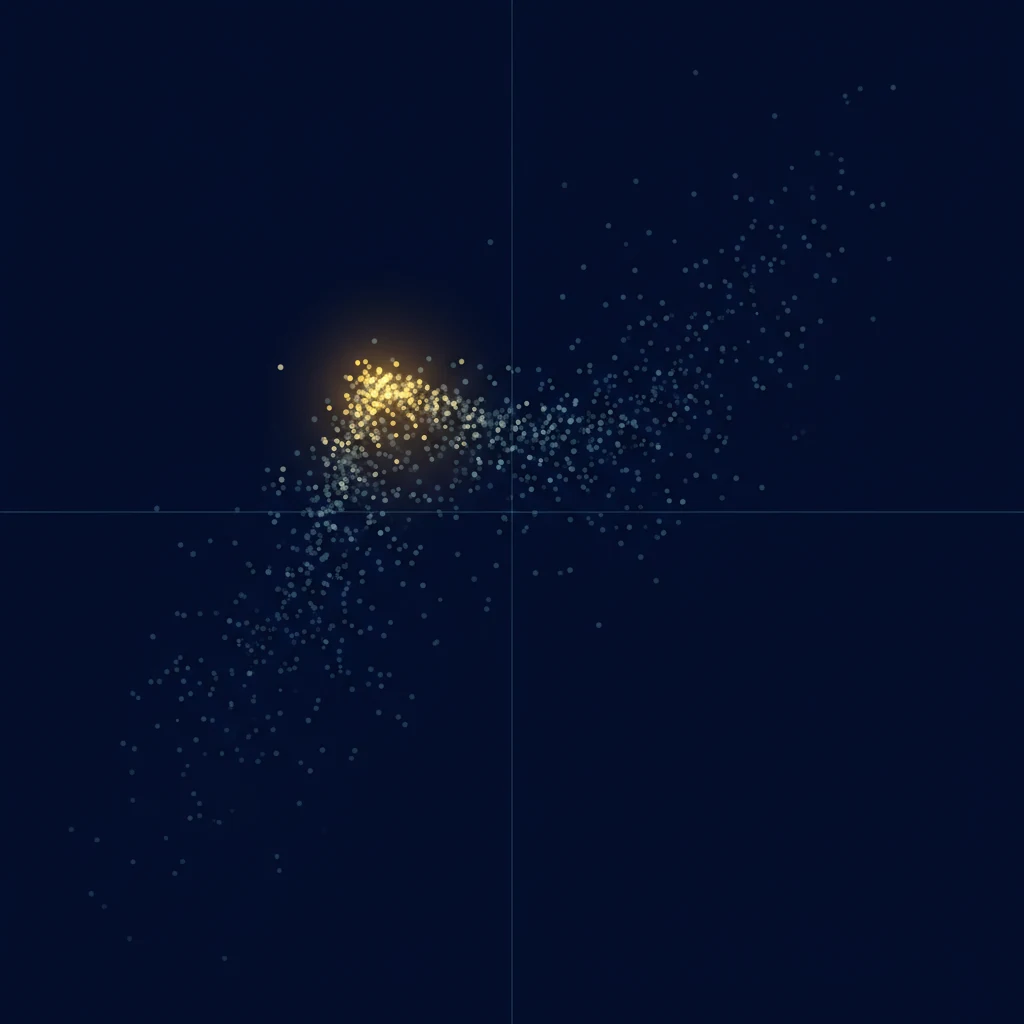
Ask a 17-year-old what they want from a college major and you'll usually hear two things: it should pay well, and it shouldn't get wiped out by AI. The quiet assumption underneath is that these travel together — that the smart, lucrative, "safe" majors are also the ones insulated from automation. When we ran the numbers across all 24,479 bachelor's programs in our dataset, that assumption fell apart. If anything, the highest-paying majors are the most exposed to what large language models can already do.
We paired each program's first-year earnings (from the U.S. Department of Education's College Scorecard) with an AI task-exposure score — the occupation-weighted share of a field's core tasks that current AI systems can meaningfully perform. The relationship between the two isn't a coin flip and it isn't the reassuring inverse most people expect. It's a modest but consistent positive correlation: Pearson r = 0.23 across all 24,479 programs, and 0.19 across the 164 majors with enough programs to average. Higher pay comes, on average, with slightly higher AI exposure. Pay does not buy you safety; sometimes it buys the opposite.
That number — 0.23 — deserves a caveat before anything else. It is a tilt, not a law. Pay explains only a small slice of the variation in exposure, and there are well-paid, low-exposure majors and poorly-paid, high-exposure ones scattered throughout. But the direction is the point, because so many people assume it runs the other way.
What "exposure" means here — and what it doesn't
Our exposure score blends three peer-reviewed measures of AI task overlap: OpenAI's GPTs-are-GPTs occupational study, Felten's AI Occupational Exposure index, and the Frey-Osborne automation estimates. For each program we map its degree to the occupations its graduates actually enter, then take an employment-weighted average of those occupations' exposure. A score near 1.0 means most of the role's tasks fall inside what today's models can do; a score near 0 means very few do.
Here is the part that matters, and where careless writing goes wrong: exposure is not a wage cut, and it is not a death sentence. It measures the surface area of disruption, not the outcome. Nominal wages are sticky — when AI absorbs part of a job, firms tend to cut headcount and slow hiring long before they cut anyone's salary. That's why DegreeOutlook's own model doesn't treat exposure as a pay haircut. It treats it as a raised probability of not landing or keeping the target-field job — of sliding instead into underemployment at roughly a $45,000 fallback wage — and it prices that risk across three scenarios (optimistic, base, and pessimistic) rather than betting on any single future. A high exposure score is a flag to look harder, not a verdict that the career is over.
Four kinds of major
Split every major at the median on both axes — the median major earns about $40,000 in year one and carries an exposure score around 0.47 — and you get four quadrants. Two of them contain the high-paying majors, and they behave very differently:
- High pay, high exposure (47 majors): the largest of the high-paying group. Computer science, computer engineering, statistics, and much of core engineering live here.
- High pay, low exposure (35 majors): the smaller, more durable group. Overwhelmingly clinical, applied, and physical work.
Among the high-paying majors, in other words, the AI-exposed ones outnumber the insulated ones. At the individual-program level the same tilt holds: 31% of all programs are both above-median pay and above-median exposure, versus 19% that pair high pay with low exposure. The "safe and well-paid" corner is real, but it's the minority.
The high-payers that aren't as safe as they sound
The majors that dominate every "smart kid" shortlist — computer science, computer engineering, statistics — are exactly the ones sitting deepest in the high-exposure zone. That isn't an accident. These fields concentrate on programming, quantitative analysis, and structured writing, which are precisely the tasks large language models perform best. The same OpenAI study we use found that programming and writing skills are the strongest positive predictors of exposure, while science and critical-thinking skills point the other way.
| Major | First-year pay | AI exposure (0–1) |
|---|---|---|
| Computer Engineering | $78,695 | 0.71 |
| Electrical Engineering | $77,517 | 0.56 |
| Computer Science | $73,714 | 0.72 |
| Chemical Engineering | $72,288 | 0.48 |
| Mechanical Engineering | $70,527 | 0.53 |
| Civil Engineering | $69,097 | 0.49 |
| Statistics | $63,187 | 0.64 |
| Biomedical Engineering | $63,751 | 0.50 |
Note the nuance inside engineering, because it complicates the usual "just do engineering" advice. The disciplines — mechanical, civil, chemical, biomedical — carry moderate-to-high exposure (0.48–0.53), because their mapped occupations involve a lot of computation, modeling, and documentation. Engineering is not a blanket AI-safety play. As we've argued in our look at the degrees most exposed to AI, the exposure lives in the tasks, and a surprising amount of high-status technical work is task-exposed.
Check Your Specific Program
Exposure and earnings both swing hard by school and major. See the numbers, and the three AI scenarios, for your exact program.
Explore Degree Values →The fields that actually pair pay with insulation
The genuinely durable high-payers — strong first-year earnings and below-median exposure — are almost all hands-on, clinical, regulated, or physical. These are the majors that rarely top a prestige list, and they are where the pay-and-safety combination actually lives.
| Major | First-year pay | AI exposure (0–1) |
|---|---|---|
| Registered Nursing | $75,274 | 0.39 |
| Industrial Engineering | $73,874 | 0.43 |
| Aerospace Engineering | $73,060 | 0.41 |
| Electrical Engineering Technology | $67,107 | 0.41 |
| Clinical / Medical Laboratory Science | $65,728 | 0.24 |
| Quality Control & Safety Technology | $63,917 | 0.39 |
| Mechanical Engineering Technology | $62,227 | 0.28 |
| Dental Support Services | $60,938 | 0.24 |
| Industrial Production Technologies | $60,267 | 0.27 |
| Allied Health Diagnostic & Treatment | $59,453 | 0.28 |
Nursing is the flagship of this quadrant: it pays like an engineering degree ($75,274 in year one) while scoring 0.39 on exposure, because bedside assessment, physical care, and in-the-room judgment don't compress into a prompt. The pattern repeats across the medical-laboratory, allied-health, and skilled-technical fields, and it maps onto our separate finding that only a handful of paths combine strong ROI with real automation resistance — the shortlist we walk through in AI-proof careers worth studying for. It's a small list for a reason: this quadrant is the exception, not the rule.
Why the two goals pull apart
The correlation isn't mysterious once you name what's underneath it. The modern labor market pays a premium for cognitive, text-and-data work — and cognitive, text-and-data work is exactly what language models are built to do. The fields that resist AI resist it because they're anchored in the physical and interpersonal world: a body to examine, a machine to repair, a structure to inspect, a room to be in. Historically that kind of work paid less than desk work, which is why "safe from AI" and "well paid" ended up on opposite ends of the same axis. AI didn't create that divide; it just made it matter for majors people used to consider bulletproof.
This is also why a high salary is such a poor proxy for safety. The salary reflects today's demand for a skill; the exposure score reflects how much of that skill a machine can now imitate. When the thing you're paid well for is the thing a model does cheaply, the premium is the target, not the shield. That tension — today's paycheck sitting on top of tomorrow's exposure — is the single most useful thing a student can hold in their head while picking a major, and it's why we treat first-job risk and AI exposure as two separate questions in the two risks every major carries.
What this analysis can't tell you
The major-to-job map is fuzzier for some fields than others. We assign exposure by mapping a degree to the occupations its graduates enter. For nursing or medical-laboratory science that mapping is nearly one-to-one, so the score is tight. For generalist majors — business, communications, liberal arts — graduates scatter across dozens of occupations, and a single exposure number smooths over a lot of variance. Read those with more caution than the vocational fields.
First-year earnings are a snapshot, not a forecast. Scorecard reports pay one year out, which understates fields with long ramps (law, medicine, academia) and can't see how AI will reshape wages a decade from now. The exposure score is forward-looking; the pay figure is not. Don't read either as a prediction of your career-long income — use them as two inputs, measured on different clocks.
Exposure is a probability, not a prophecy. A 0.72 doesn't mean 72% of computer scientists lose their jobs. It means a large share of the work is within reach of current tools, which raises the odds of a harder market — and which some graduates will turn into leverage rather than loss. That's why we model three scenarios instead of one, and why we'd never tell a student to abandon a field they're strong in over an exposure score alone.
The bottom line
If you're choosing a major and you want both a good income and some protection from automation, the worst thing you can do is assume the paycheck implies the protection. In this data it slightly implies the reverse. The prestige-adjacent, high-paying "smart" majors — computer science, statistics, much of engineering — carry the highest exposure, while the pay-and-safety combination hides in the clinical, applied, and hands-on fields most college guides barely mention. You don't have to pick safety over pay. But you do have to check both numbers, separately, for the specific major you're weighing — because one of them is quietly telling you something the other can't.