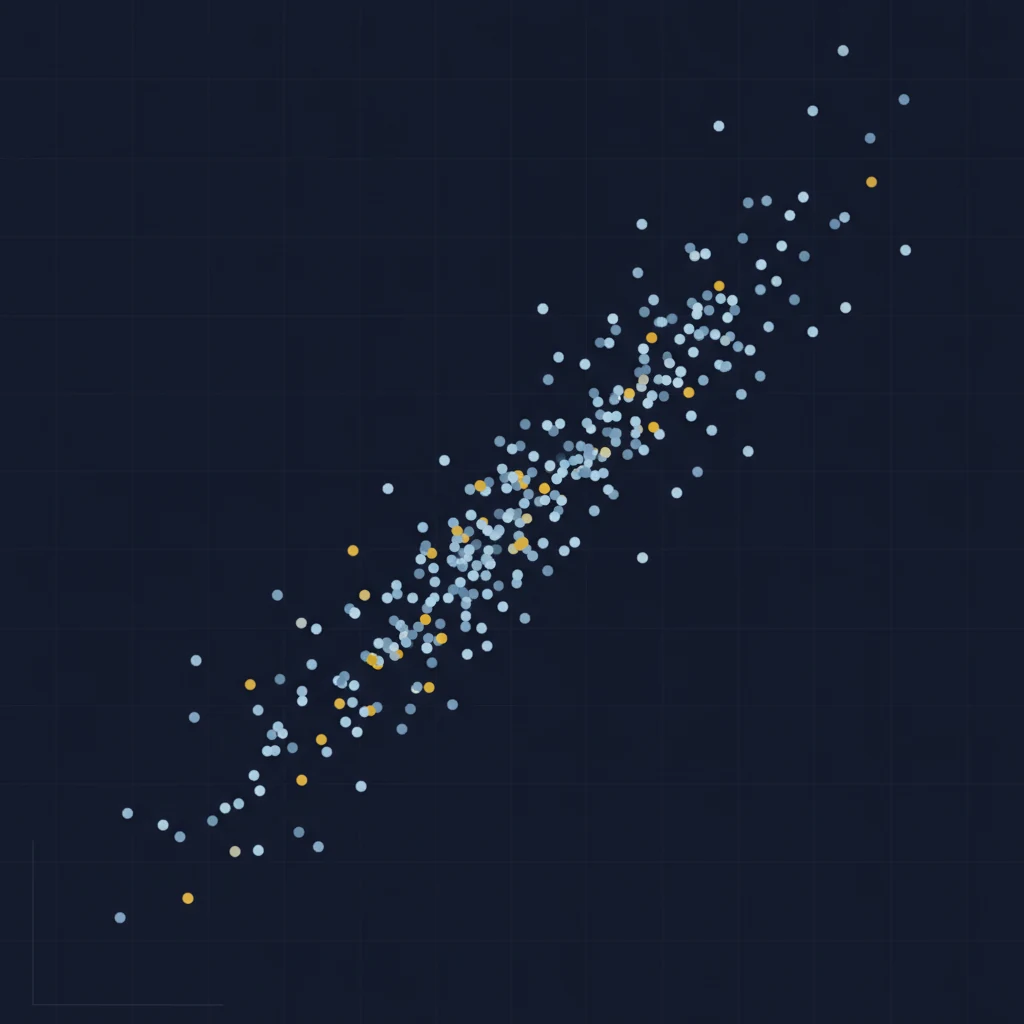
The headline number from the New York Fed's most recent recent-graduate report is 39.4%. That's the share of bachelor's holders age 22 to 27 working in jobs that don't require a college degree at all. Not "underpaid for their field." Not "stuck in a starter role." Working at jobs where the degree is — for the function performed — not required.
The other thing the report shows is that this national average hides an enormous spread. Nursing graduates have a 12.8% underemployment rate. Criminal Justice graduates have a 65.8% rate. A 5.1× difference in how often the degree actually gets used, depending on which major sits on the diploma. That spread is mostly absent from how college rankings frame their results.
Now layer on a second risk. The 2023 wave of large-language-model deployment forced labor economists to publish actual exposure scores for individual occupations — Felten, Raj & Seamans's AIOE and OpenAI's "GPTs are GPTs". The exposure scores don't line up cleanly with the underemployment scores. Some "safe" majors on one axis are exposed on the other; some majors look terrible on one and fine on the other. Our underlying model blends both with BLS occupational projections to produce a single ROI estimate, but most degree-shoppers never see the two component risks laid out side by side. That's what this post does.
Risk one: the underemployment dimension
Underemployment is the cleanest signal in higher-ed labor data because the criterion is mechanical: BLS classifies each occupation by its typical entry-education requirement, and the New York Fed simply counts how many recent grads from each major are working in occupations whose entry requirement is below "bachelor's." There is no story here, no projection — just a counted match between the major a person earned and the credential their current job actually needs.
The distribution across 73 majors is wider than most prospective students realize:
| Tier | Underemployment rate | Representative majors |
|---|---|---|
| Low | Under 20% | Nursing (12.8%), Aerospace Engineering (14.7%), Civil Engineering (15.6%), Computer Engineering (15.8%), Special Education (16.0%), Elementary Education (16.2%), Construction Services (17.9%), Chemical Engineering (17.9%), Computer Science (19.1%) |
| Moderate | 20% – 35% | Mechanical Engineering (20.1%), Electrical Engineering (21.1%), Accounting (21.2%), Mathematics (26.2%), Finance (27.8%), Pharmacy (30.5%), Physics (29.1%), Economics (33.1%) |
| Elevated | 35% – 50% | Biochemistry (42.0%), Chemistry (42.8%), Journalism (43.3%), Health Services (45.1%), Public Policy (45.5%), Psychology (48.3%), Philosophy (47.1%), Medical Technicians (47.0%) |
| High | Over 50% | History (50.1%), Environmental Studies (50.5%), Biology (51.1%), Sociology (52.0%), Mass Media (52.1%), Business Management (52.6%), Communications (53.0%), Liberal Arts (54.6%), Fine Arts (58.9%), Performing Arts (63.9%), Criminal Justice (65.8%) |
Two patterns stand out. The first is that licensure and scarce technical skills compress the rate hard. Nursing requires a state license; aerospace and chemical engineering require coursework that's hard to backfill on the job. Those credentials act as a hiring filter that keeps non-degree-required substitutes out. The second pattern is that "broad" majors fare worst — Communications, Business Management, Liberal Arts, Criminal Justice. Not because graduates of those programs are less capable, but because the labor market doesn't gate the relevant roles on the diploma. A bachelor's in Communications doesn't unlock a job profile that a high-school graduate is structurally excluded from.
The New York Fed's methodology is worth one important caveat. The rate measures the 22-to-27 window. By their 30s, a meaningful share of "underemployed" graduates have moved into degree-level roles — the rate at 35-44 is materially lower for nearly every major. The early-career number is the right one to use for the question "how likely is the diploma to get used right after I graduate," and that's the question this post is about. It's not the right number for "will my degree pay off over a 40-year career," which is what our ROI rankings address using lifetime-earnings data.
Risk two: the AI exposure dimension
Underemployment is a snapshot of the current labor market. AI exposure is a forward-looking estimate of how much of a job is in scope for automation by current and near-term large language models. The exposure score doesn't predict whether a worker will be replaced — most exposed occupations will be transformed rather than eliminated. It predicts that the wage and headcount equilibrium for the occupation will be re-priced as the work gets cheaper to produce.
What makes AI exposure orthogonal to underemployment is the mechanism. Underemployment is gated by licensure and credential-screening: a Nursing degree clears that filter handily. AI exposure is gated by task composition: a job's exposure depends on how much of its activity is text generation, code generation, image manipulation, structured analysis — exactly the surface where current models are getting good fastest. The two have nothing in common as predictive variables.
Concretely, that means the picture for some majors changes dramatically when you switch axes:
- Accounting has a moderate underemployment rate (21.2%), so the early career looks fine. AI exposure for accountants and auditors is in the upper third of all occupations — much of the structured reconciliation, audit-prep, and tax-prep work is in-scope for current models. The risk isn't the first job; it's the wage trajectory once mid-level accounting work gets cheaper to produce.
- Computer Science has the second-lowest underemployment rate (19.1%) among non-engineering majors. AI coding tools are also among the most-deployed productivity applications in the labor force. Software developers face genuine task-displacement risk at the same time the major's early-career match rate looks strong.
- Nursing has the lowest underemployment rate (12.8%) and one of the lowest AI exposure scores of any bachelor's-route career. Patient assessment, intervention, and inter-team coordination resist text-model substitution. Both risks are low. The two-axis test is part of why nursing keeps surfacing on our AI-resistant degree rankings.
- Mathematics and Physics have moderate underemployment (26.2% and 29.1%) and depend heavily on what graduates do downstream. Quant-finance and ML-research roles are highly AI-exposed; teaching and pure research are less so.
- Education majors have low underemployment (Elementary 16.2%, Special Ed 16.0%) and low AI exposure. The labor market reliably absorbs new teachers, and primary-school teaching is among the least exposed of all bachelor's-level occupations. The well-documented compensation problem for K-12 teaching is real and shows up in our ROI rankings — but the labor-market risks here are unusually low.
The four quadrants
Cross the two axes and four meaningful regions appear. Each implies a different relationship between the student and the degree.
Low underemployment + low AI exposure: the safe quadrant. Nursing, Civil Engineering, Special Education, Elementary Education, Construction Services. The major is screened by licensure or specialized technical skill, and the work itself is hard to displace with current models. This is also the smallest quadrant — fewer than a dozen bachelor's pathways sit here. The major is doing exactly what marketing materials promise: producing graduates who reliably end up in jobs that need the credential.
Low underemployment + high AI exposure: the leveraged quadrant. Computer Science, Accounting, parts of Finance, parts of Computer Engineering. Strong early-career placement, but the long-tail wage curve is a bet that the worker can move up the value chain faster than AI eats the entry-level rungs. Historically these majors have been among the highest-ROI bets in the entire degree universe — and they may continue to be — but the risk profile is "still pays well, just for different reasons than five years ago." Graduates should plan for a faster pivot from "doing the work" to "supervising and directing the work."
High underemployment + low AI exposure: the credential-gap quadrant. Criminal Justice, parts of Liberal Arts, History, Sociology, Anthropology. Many of the occupations these graduates eventually enter aren't AI-exposed — but they also don't require the degree. The risk isn't displacement; it's that the bachelor's never gets converted into a wage premium because the labor market wasn't gating the relevant roles on it in the first place. This quadrant is where the "is the degree worth it" question is sharpest, and where the answer depends almost entirely on whether the student has a specific post-graduation path in mind that does need a bachelor's (law school, social work licensure, a teaching credential, federal-service GS-9 eligibility).
High underemployment + high AI exposure: the compound-risk quadrant. Business Management, Communications, Mass Media, Marketing, some Humanities. The early-career match rate is poor and the long-tail task composition is exactly where AI tools are improving fastest. These are not "bad" majors in any moral sense — many of the most successful careers in the modern economy start with a Communications degree — but the prospective student needs to be honest that the diploma is not what's doing the work. The differentiator becomes the portfolio, the network, and the post-graduation specialization. The degree itself is increasingly a check-the-box prerequisite rather than a value-creating credential.
Reading the matrix without picking winners and losers
It would be easy to read the matrix as a ranking — best quadrant to worst quadrant. That reading is a mistake for a specific reason: a major's quadrant tells you what kind of risk you're taking, not whether you should take it. The risk is information for the student to weigh against everything else they know about themselves.
The compound-risk quadrant is genuinely high-variance. A Communications grad who writes well, builds a portfolio, and lands at a growth-stage tech company can out-earn most engineers within a decade. The same Communications grad who graduates without portfolio, network, or a specific role in mind has a 53% chance of working a non-degree-required job at age 25. The major didn't determine the outcome; the post-graduation specialization did. The data is telling you that the variance is unusually high — not that the floor is the median.
Conversely, the safe quadrant is not free money. Nursing and the trade-adjacent engineering disciplines have very low underemployment rates but also relatively flat wage ceilings in many regions, and they extract significant ongoing certification and continuing-education burdens. Those are real costs that don't show up in the underemployment numbers and that need their own consideration.
The matrix is most useful before a major is chosen, not after. If a prospective student is choosing between Communications and Marketing, both sit in the compound-risk quadrant; the more useful next question is "what specific role does this lead to" and not "which major has the slightly better underemployment number" (which is roughly noise at that resolution). If the choice is between Chemical Engineering and Biology, the underemployment delta (17.9% vs 51.1%) is enormous and meaningful. The matrix's job is to surface which choices are real choices versus which ones are noise dressed up as choice.
What this changes about how to evaluate a major
Three concrete shifts follow from holding both risks in view at once.
First, the question changes from "what's the average salary for this major" to "what's the conditional salary, given a graduate in fact ends up in an occupation that requires the major." College Scorecard reports the unconditional average — including the underemployed share. For a major with a 50%+ underemployment rate, the conditional average is meaningfully higher than the reported one and the unconditional average is meaningfully lower. Both are real numbers describing different populations. Knowing which one applies to you matters.
Second, AI exposure is most informative as a direction rather than a magnitude. Models are improving fast enough that any specific exposure score will look different in three years. What's stable is the directional signal: routine text generation, structured analysis, tabular data manipulation, image production, and code generation are in scope; physical patient care, on-site construction supervision, K-12 teaching, and inspection-licensed work are not. Choosing a major that compounds value over a 40-year career means choosing one whose downstream occupations sit on the right side of that line, broadly.
Third, the matrix makes the "what should I major in" question more answerable, not less. Most college-major guides flatten the question into a single ROI number. The two-axis frame separates "early-career match" from "long-run task exposure" and lets the student weight them against their own situation: a debt-averse 18-year-old should overweight the underemployment risk; a student planning a 35-year career in fields with high AI substrate should overweight the exposure dimension; a student with strong family support and a specific downstream role in mind can afford to ignore both. Our companion analysis on AI-proof careers walks through the same data from the career-outcome side; the major-side view is the lens this post argues for.
The honest summary
Federal data lets you measure two real risks that act on every bachelor's degree: how often the degree actually gets used in the first job, and how exposed the downstream work is to displacement by current AI systems. Both numbers exist. Neither is hard to compute. Most rankings show neither. That gap is the most useful thing the matrix reveals — not that one quadrant is best, but that the conversation about choosing a major has been happening with half the relevant information.
The data sources, methodology, and source citations behind every number above are documented in our methodology page. The underlying datasets come from the Federal Reserve Bank of New York Labor Market for Recent College Graduates, U.S. Department of Education College Scorecard, BLS Occupational Employment and Wage Statistics, and the published AI-exposure datasets cited above. The values referenced are as of Q4 2025 for FRBNY and the most recent available release for the federal data.