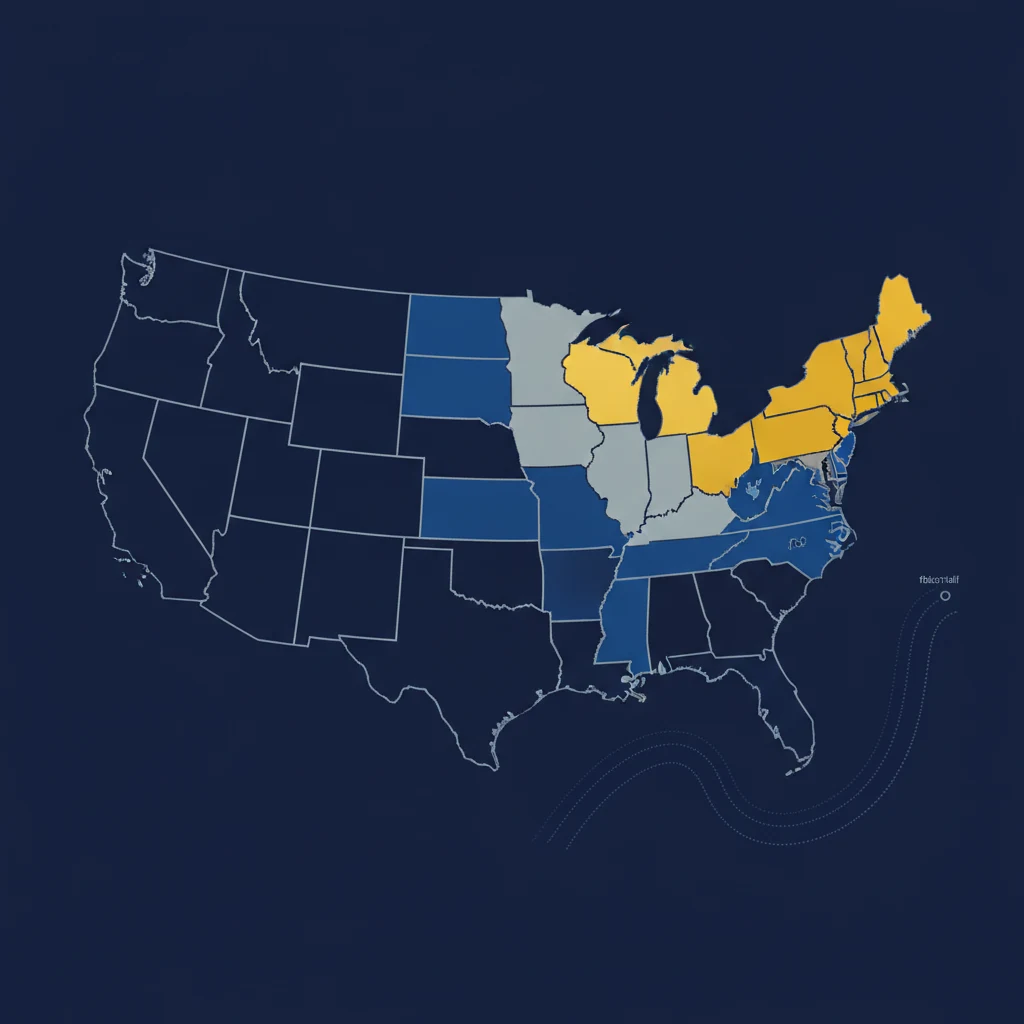
On April 17, 2026, the Department of Education quietly published a Notice of Proposed Rulemaking that does something the federal student loan system has never done at this scale: it ties Title IV eligibility to whether a program's graduates out-earn the local high-school grad. The rule's official name is forgettable — Accountability in Higher Education and Access Through Demand-Driven Workforce Pell: Student Tuition and Transparency System (STATS) and Earnings Accountability — but the mechanism is sharp. If a bachelor's program's typical graduate earns less than the median 25–34-year-old high school graduate in the same state, the program is flagged. Two failures out of three consecutive years and the program loses federal Direct Loans.
The state-specific part is where this gets interesting. The Department of Education's own published thresholds for the 2024 calculation year ranged from $26,372 in Mississippi to $37,850 in New Hampshire. Same federal rule, eleven thousand dollars of swing. We pulled every bachelor's program in College Scorecard with five-year post-completion earnings data — 20,264 of them — and ran them against both ends of that range. The result is a small but specific set of programs that sit in a geographic risk zone the policy press hasn't been talking about.
What the rule actually proposes
The proposal replaces the existing Gainful Employment regime, which historically applied only to non-degree programs at non-profits and to all programs at for-profits. The new framework covers every postsecondary program at every institution type — public, private nonprofit, and proprietary — across bachelor's, associate's, certificate, and graduate levels. It drops the old debt-to-earnings metric and keeps only the earnings premium test.
For undergraduate programs, the comparison runs against the median earnings of working adults aged 25–34 with only a high school diploma. For graduate programs, the benchmark steps up to the median for adults the same age with a bachelor's degree. Programs that fail in two of three consecutive years lose access to Direct Loans. In some configurations Pell Grant eligibility may also be affected.
The geographic logic is one sentence in the NPRM, but it carries most of the weight: the comparison runs against earnings in the state where students live, unless fewer than 50% of the institution's enrolled students reside in that state, in which case a national figure substitutes. For most public flagships, regional publics, and tuition-driven privates whose students are predominantly in-state, the local threshold applies. For online-heavy institutions, large privates with national draws, and any program whose enrollment is geographically diffuse, the national figure rules. We'll come back to this — the state-vs-national split is where the framing lives or dies.
The comment period closes May 20, 2026. Final rules are expected to take effect July 1, 2026, with the first earnings-test calculations running in early 2027. Programs could begin losing loan access as soon as July 1, 2028. The Federal Register carries the full text; NASFAA's compiled summary is the most navigable secondary read.
The state thresholds, ranked
The Department's published 2024 reference table sets a floor of $26,372 (Mississippi) and a ceiling of $37,850 (New Hampshire). Most states cluster between $30,000 and $35,000. The structural fact is that the same field of study at the same credential level can clear the threshold in low-wage states and miss in high-wage states — even though the program produced the exact same outcome. The federal rule absorbs the regional cost-of-living spread directly into eligibility.
This isn't an accident of the formula. The Department's argument for state-anchoring is that a degree's value should be judged against the local labor market, not a national average that flattens regional differences. Whether that's the right call is a normative question; the operational consequence is that a graduate's loan eligibility now depends on geography in a way it hasn't before.
Which bachelor's programs sit in the danger zone
We sorted Scorecard's 20,264 bachelor's programs into three buckets based on five-year post-completion earnings. Five-year earnings are the closest proxy in the public dataset to the metric ED appears to be using; the actual rule will draw from comparable but not identical IRS-derived earnings data, so treat the program counts as directional rather than literal.
- 108 programs (0.5%) sit below $26,372 — they would fail in every state, including the lowest-threshold ones.
- 856 additional programs sit between $26,372 and $37,850 — they would clear in low-threshold states like Mississippi, Alabama, or West Virginia, but fail in high-threshold states like New Hampshire, Massachusetts, or Connecticut.
- 19,300 programs (95.2%) clear $37,850 and pass the test regardless of state.
The fields most concentrated below the lowest state threshold are predictable — performing arts, fine arts, dance, music, and religion lead the list. A handful of accounting, criminal justice, and psychology programs also appear, almost always at small institutions with limited employment infrastructure.
| Field of study | Programs below $26,372 | Mean 5-yr earnings |
|---|---|---|
| Drama & theatre arts | 19 | $22,625 |
| Fine & studio arts | 6 | $23,686 |
| Music | 6 | $23,855 |
| Dance | 6 | $22,704 |
| Religion / theological studies | 5 | $20,240 |
Our existing worst-ROI degrees ranking overlaps with this list but isn't identical — Scorecard's earnings data captures program × institution combinations, so a fine arts BFA at one school can fail while the same major at a better-placed school clears comfortably.
The middle band — programs that fail only in high-threshold states — is where the geography wrinkle lives. The most-affected fields are the same arts-and-humanities clusters, but with much larger program counts, plus one that surprises: 31 BSN nursing programs whose five-year earnings sit comfortably above the Mississippi floor but below the New Hampshire ceiling.
| Field of study | Programs in danger zone | Notes |
|---|---|---|
| Drama & theatre arts | 126 | — |
| Fine & studio arts | 116 | — |
| Music | 49 | — |
| English language & literature | 45 | — |
| Psychology | 37 | — |
| Nursing (BSN) | 31 | Mean 5-yr earnings $32,949 |
The BSN finding is the one most likely to catch readers off guard. A program in a high-cost state with low first-year placement wages could be flagged even though nurses are universally regarded as a high-employment outcome. ED's earnings window matters; nursing graduates' earnings rise sharply between years 5 and 10, but the rule reads year-five.
The geography of loan risk, in two examples
The framing that makes this rule feel new is also the one most likely to be misread. The state used in the comparison is the state where students reside, not where the school is located. For a public flagship enrolling 85% in-state students, the two are almost identical. For a regional private drawing students nationally, the school's home state is irrelevant — the comparison defaults to the national figure. This is the part the rule's text resolves cleanly and most coverage hasn't.
So the practical "same degree, different state" exposure looks like this in the field. A bachelor's in studio art at a public regional university in Mississippi, with $24,800 median five-year earnings, would clear Mississippi's $26,372 threshold by a hair if its enrolled student body skews in-state. The same studio art bachelor's at a public regional university in New Hampshire, producing the same $24,800 earnings outcome, would miss New Hampshire's $37,850 threshold by more than $13,000 — and would face the loss-of-loans clock the moment the rule goes live. The program's quality didn't change. The state did.
For institutions with national reach, the comparison shifts to a national high-school earnings figure (per the Department's framework, drawn from the same age-25–34 ACS 5-Year Estimates). National figures sit roughly mid-range in the published distribution, which means online-heavy institutions and large privates face a moderately higher bar than they would in low-threshold states but a lower one than they would in the Northeast. The administrative simplification masks the underlying point: where you study now interacts with what you study to determine federal aid eligibility, in a way it didn't before.
Caveats that matter
Three things keep the headline number honest. First, this is an NPRM. The 30-day comment period closes May 20, 2026, and the higher-education sector — particularly arts conservatories and small liberal arts colleges, which have an obvious interest — is filing pointed comments. The final rule will likely retain the earnings-premium architecture but could move on cohort-size exemptions, the 50% in-state threshold, and how transition years are handled. Treat the program counts above as a planning estimate, not a forecast.
Second, there's a cohort-size exclusion floor. Programs with very small completer counts (the existing Gainful Employment / Financial Value Transparency rules used roughly 30 completers averaged over a measurement window) are excluded from accountability calculations. A meaningful share of the 108 unambiguous-failure programs above are at small institutions with cohorts that would be exempt. The 0.5% headline overstates the at-risk universe.
Third, the failure mechanism requires two failures out of three consecutive years, and the first calculation isn't until early 2027. A single weak earnings cohort doesn't end aid. Programs have a real window — multiple years — to either improve placement outcomes, restructure, or make the case for a measurement-period exemption.
What current and prospective students should do
For prospective bachelor's students considering programs in the most-exposed fields — drama, fine arts, dance, music, religion — the practical implication is that program-level earnings transparency is about to become operationally meaningful, not just informational. A program's Scorecard earnings page is no longer a soft signal; it's a leading indicator of whether the program will still accept federal loans by the time you graduate. The federal data is publicly available; checking it before enrolling is now a basic due-diligence step rather than an over-cautious one.
For current students already enrolled in flagged programs, the rule does not retroactively pull federal loans. Disbursements continue under existing terms. The risk is that a program loses Title IV eligibility for new entrants, which can affect institutional viability and — for arts conservatories that depend disproportionately on federal aid — could trigger program closures during the 2027–2028 cycle.
For graduate students, the parallel rule (compared against bachelor's-degree-holder earnings rather than high-school earnings) is more aggressive in its scope and is worth reading separately. The dynamics there interact directly with the OBBBA Grad PLUS cap that took effect July 1, 2025, which we covered in our 2026 student loan changes analysis. For undergraduates weighing AI-resilient career paths, our AI-proof careers analysis is a useful complement — programs that pass the earnings floor and survive AI exposure are a narrower set than either filter alone suggests.
The most important thing to internalize is that a federal rule has, for the first time, made geographic context part of the value equation for a college credential. Whether that's the right policy is something the comment period is deciding. Whether it changes the calculation for prospective students is already settled: it does, and the data to act on it is public.
Methodology: Bachelor's program earnings data from College Scorecard (most recent available release, 5-year post-completion median earnings by program × institution). State thresholds from the Department of Education's published 2024 reference calculation. Rule mechanics from the April 17, 2026 NPRM and supporting ED press materials. The exact metric ED will use in production may differ from Scorecard 5yr earnings; treat figures as directional. We do not apply cohort-size exemptions in our counts.